

 EN
EN

 English
 русский
 Français
 Español
 عربى
عربى


What MGG Fixed Bus-Bar Supports Are and How to Specify Them
Content
- 1 Fixed Support Type Functions in Busbar Systems
- 2 MGG Series Bus-Bar Diameter Coverage
- 3 Material Selection Impact on Substation Service Life
- 4 Differences Between Fixed, Sliding, and End Supports
- 5 Field Installation Procedures
- 6 Applicable Standards and Certifications
- 7 Procurement Guidelines and Order Requirements
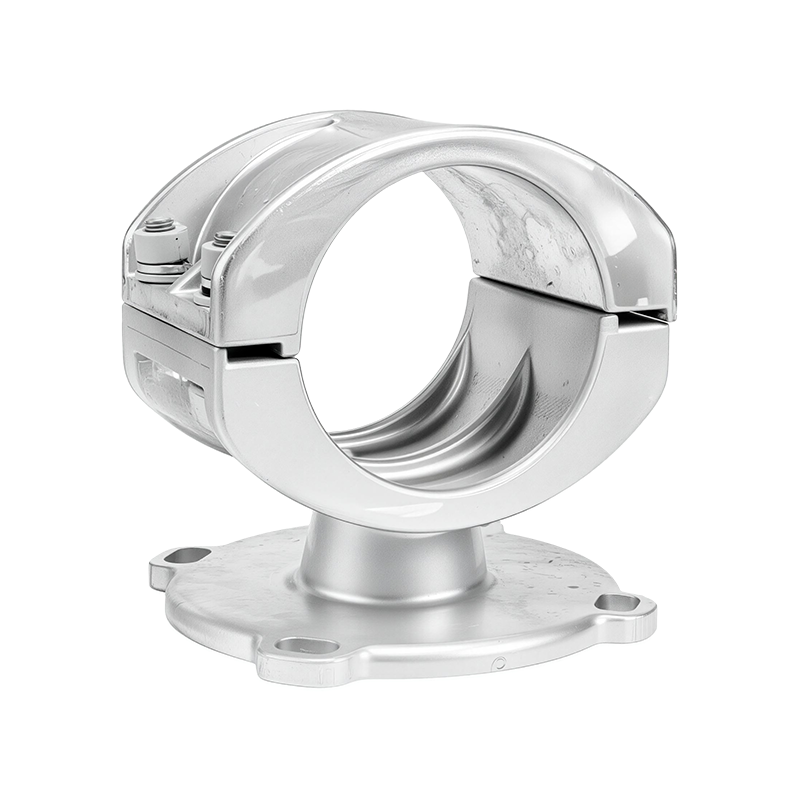
The MGG fixed support type bus-bar support is the standard mechanical anchor for aluminum alloy tubular busbars in power substations. It locks the busbar in place axially, preventing longitudinal movement while transferring mechanical loads to the support structure. For any substation engineer specifying tubular busbar fittings, this is the foundational clamp — not interchangeable with the sliding type, and not optional in a rigid-span layout.
MGG Fixed Bus-Bar Support
IEC / ANSI / GB
Aluminum Alloy (Body & Keepers)
Hot-Dip Galvanized Steel
Fixed Support Type Functions in Busbar Systems
In a tubular busbar run, not every support plays the same role. The fixed support type — designated MGG — serves as the anchor point that holds the busbar stationary against both vertical loads and horizontal forces along the busbar axis. This is structurally different from a sliding (expansion) support, which allows longitudinal movement to accommodate thermal expansion.
In practice, every busbar span must have at least one fixed support. The remaining supports are typically expansion type (MGS), which permit controlled sliding. This combination allows the busbar to expand and contract with temperature changes — which in outdoor substations can exceed 50 degrees Celsius seasonally — without generating destructive stress at connection points.
The MGG clamps the tubular conductor firmly by compressing keeper plates against the busbar surface. The clamping bolts feature hex-stops, allowing installation with a single wrench. Cap screws are also supplied for upright (vertical post) mounting configurations.
MGG Series Bus-Bar Diameter Coverage
The MGG series spans a wide range of tubular busbar diameters, from 50 mm up to 250 mm outer diameter. Each catalog number encodes the nominal busbar size, and the dimensional parameter C (the mounting bolt circle) can be specified on order when non-standard values are needed. The table below lists the standard MGG catalog numbers with their applicable busbar outer diameters and key dimensions:
| Catalog No. | Busbar OD (mm) | Dimension c (mm) | Dimension d (mm) | Dimension h (mm) |
| MGG-50 | 50 / 54 | 140 | 14 | 80 |
| MGG-60 | 60 / 54 | 140 | 14 | 90 |
| MGG-80 | 80 / 72 | 140 | 14 | 98 |
| MGG-100 | 100 / 90 | 140 | 14 | 114 |
| MGG-130A | 130 / 116 | 190 | 18 | 135 |
| MGG-150A | 150 / 136 | 190 | 18 | 150 |
| MGG-170A | 170 / 156 | 190 | 18 | 170 |
| MGG-200B | 200 / 180 | 225 | 20 | 190 |
| MGG-250B | 250 / 230 | 225 | 20 | 190 |
| MGG-250D | 250 / 230 | 280 | 20 | 190 |
The suffix letters (A, B, C, D) indicate variants with different mounting bolt circle dimensions (c = 140, 190, 225, 254, 280 mm), allowing the same busbar diameter to be installed on different insulator post heights and support structure geometries.
Material Selection Impact on Substation Service Life
The MGG support uses aluminum alloy for the body and keeper plates, and galvanized steel for the bolts and fasteners. This combination is deliberate.
Differences Between Fixed, Sliding, and End Supports
The tubular busbar fitting family includes several support types that serve different mechanical functions. Understanding the differences prevents misapplication:
Locks busbar against axial movement. Used as the anchor point in each span. Does not allow thermal expansion movement. Typically one per continuous run segment.
Allows the busbar to slide axially while providing vertical support. Accommodates thermal expansion and contraction. Used alongside fixed supports to prevent stress buildup.
Designed for the terminal ends of a busbar run. Provides end-capping and mechanical termination, often used in conjunction with dead-end fittings.
In outdoor 110 kV and above substations, the typical design practice is to place one MGG fixed support per insulator post group, then specify MGS sliding supports for all intermediate spans. For a 20-meter aluminum tubular busbar run operating in a climate with a 60-degree temperature range, thermal expansion of approximately 1.4 mm per meter would occur (aluminum thermal expansion coefficient of approximately 23 micrometers per meter per degree Celsius), meaning the busbar could expand or contract by roughly 28 mm across its full length. Without sliding supports, this expansion generates stresses that can crack porcelain insulators or deform connection joints.
Field Installation Procedures
The MGG fixed support is designed for straightforward field assembly. The key installation considerations are:
Applicable Standards and Certifications
MGG bus-bar supports are manufactured to comply with IEC, ANSI, and GB (Chinese National Standard) requirements for substation fittings. Quality-certified manufacturers hold ISO 9001:2015 for quality management, ISO 14001:2015 for environmental management, and OHSAS 18001 for occupational health and safety.
Test facilities for MGG supports include tensile testing machines rated at 60MT and compression presses rated at 200MT, along with spectrometer analysis for alloy composition verification. Independent test reports from laboratories such as VEIKI-VNL Electric in Hungary and China Electric Power Research Institute are typically available for specification review by procuring utilities.
The HS code for these fittings is 8538900000, which covers parts suitable for use with switchgear and control gear.
Procurement Guidelines and Order Requirements
MGG fixed supports are produced in high-volume casting runs. Typical minimum order quantities from established manufacturers are 20 pieces per size, with FOB pricing in the range of USD 20 to 26 per piece for standard configurations. Production capacity at major Chinese manufacturers exceeds 1,000 pieces per month per product line.
When specifying for a project, the following information should be provided to the manufacturer:



-
 +86-180 3625 3000
-
 admin@wpbusbar.com
-
 No. 8, Yanjin Road, Chengxi Industrial Park, Shanyang Town, Baoying County, Yangzhou City, Jiangsu Province, China
Copyright © Jiangsu Wopeng Power Technology Co., Ltd.
All Rights Reserved.
 Custom Insulated Bus Bar Manufacturer
Tubular Busbar System Factory
Custom Insulated Bus Bar Manufacturer
Tubular Busbar System Factory